

Apply to a number (optional)
Enter both percentages above.
How to Use the Percentage of a Percentage Calculator
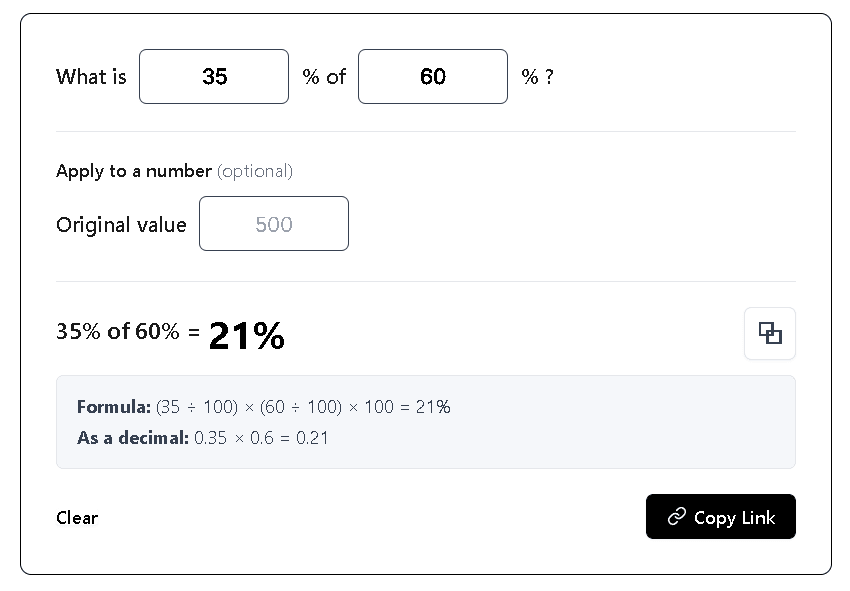
- Type the first percentage in the first box and the second percentage in the second box. The sentence reads “What is __% of __%?”
- The answer appears as you type.
- Optional: enter an original value under “Apply to a number”. The calculator then shows what each percentage does to that value, one after the other.
- Under the answer:
- Formula shows the calculation with both percentages.
- As a decimal shows the same multiplication in decimal form.
- After 1st percentage and Final value appear only when you enter an original value.
What the Calculator Accepts
- Whole numbers and decimals, such as 12.5. A comma followed by one or two digits is read as a decimal comma, so 12,5 means 12.5. Any other comma is removed as a thousands separator, so 1,000 means 1000. To be safe, use a decimal point.
- A
%or$sign and spaces are ignored, so35%and$60both work. - Negative numbers work. Two negative numbers give a positive result.
- Results are shown with up to 10 decimal places.
What Does “A Percentage of a Percentage” Mean?
A percent is a ratio whose denominator is 100. That makes “35% of 60%” easy to picture.
Imagine 100 people. Sixty of them (60%) belong to a group. Now take 35% of that group: 35% of 60 people is 21 people. Those 21 people are 21 out of the original 100, so the answer is 21%.
The second percentage sets the group you are taking from. The first percentage takes a share of that group. Because the group is smaller than the whole, the answer (21%) is smaller than 60%.
Percentage of a Percentage Formula
Result % = (P1 ÷ 100) × (P2 ÷ 100) × 100
P1 and P2 are the two percentages. A shortcut gives the same answer: multiply the two percentages, then divide by 100. For 35% and 60%: 35 × 60 = 2,100, and 2,100 ÷ 100 = 21.
Steps:
- Convert each percentage to a decimal. To do this, move the decimal point two places to the left and remove the % sign. 35% becomes 0.35 and 60% becomes 0.6.
- Multiply the decimals: 0.35 × 0.6 = 0.21.
- Convert the product back to a percentage by moving the decimal point two places to the right: 0.21 becomes 21%. You can use our decimal to percent calculator for this step.
| First percentage | Second percentage | Result |
|---|---|---|
| 10% | 50% | 5% |
| 25% | 50% | 12.5% |
| 50% | 50% | 25% |
| 75% | 80% | 60% |
| 90% | 90% | 81% |
Worked Example With an Original Value
Percentages: 35% and 60%. Original value: 500.
- Percentage of a percentage: 0.35 × 0.6 = 0.21 = 21%
- After the 1st percentage: 500 × 0.35 = 175
- Final value: 175 × 0.6 = 105
- Check: 500 × 0.21 = 105
Enter 35, 60 and 500 to see these same lines in the calculator.
Quick Checks for Your Answer
- If both percentages are 100% or less, the result is no larger than either of them. 35% of 60% is 21%, which is smaller than both.
- 100% of any percentage leaves it unchanged: 100% of 45% = 45%.
- 0% of any percentage is 0%.
- If a percentage is above 100%, the result can be larger than the other one. 150% of 140% = 210%.
- Negative numbers follow normal multiplication rules: −20% of 50% = −10%, and −20% of −50% = 10%.
Does the Order of the Percentages Matter?
Not for the percentage result. 20% of 75% is 15%, and 75% of 20% is also 15%, because multiplying in a different order gives the same product.
With an original value of 200, you reach the same final value both ways:
- 20% first: 200 → 40 → 30
- 75% first: 200 → 150 → 30
Only the middle number changes. So which percentage you enter as “1st” affects the “After 1st percentage” line, but not the final value. In a word problem, enter them in the order the problem describes them, so the middle line has a real meaning.
Percentage of a Percentage vs Percentage Points vs Percent Change
These three ideas are often mixed up, and a percentage of a percentage helps tell them apart.
Suppose a savings rate is 4% and the bank says it will rise by 15%.
- 15% of 4% = 0.6%. That is the size of the increase.
- New rate: 4% + 0.6% = 4.6%.
The same change can be described in two ways:
| Wording | Meaning | Result for a 4% rate |
|---|---|---|
| “Rises by 15%” | Percent change: 15% of the old rate | 4% → 4.6% |
| “Rises by 0.6 percentage points” | Adds 0.6 to the rate | 4% → 4.6% |
| “Rises by 15 percentage points” | Adds 15 to the rate | 4% → 19% |
The first two describe the same change. The third is a very different one. Always check whether a headline says “percent” or “percentage points”.
Statistics Canada notes that percentage change is expressed as a percentage of the first, or base, number. To compare two values with each other, use our percentage difference calculator.
Three or More Percentages in a Row
The calculator takes two percentages at a time. For three, multiply all the decimals together, or run the calculator twice, using the first answer as one of the inputs in the second run.
Example: 80%, 50% and 25%.
- 80% of 50% = 40%
- 40% of 25% = 10%
Check: 0.8 × 0.5 × 0.25 = 0.1. With an original value of 2,000: 1,600 → 800 → 200, which is 10% of 2,000.
How to Work Backwards to Find a Missing Percentage
The result equals P1 × P2, so if you know the result and one percentage, divide:
Missing percentage = result ÷ known percentage
Example: after two steps you end up with 63% of the original, and the first step keeps 90%. What does the second step keep?
- 63 ÷ 90 = 0.70 = 70%
- Check in the calculator: 90% of 70% = 63%
This calculator does not solve for a missing percentage. You do the division yourself and use the calculator to check. The known percentage cannot be 0.
Frequently Asked Questions
Q1. Can a percentage of a percentage be more than 100%?
A: Yes, if one or both percentages are above 100%. For example, 150% of 140% = 210%. If both are 100% or less, the result cannot be larger than either.
Q2. How do I use a fraction, such as 3/8, as one of the percentages?
A: Convert it to a percentage first. Use our fraction to percent calculator: 3/8 is 37.5%. Then enter 37.5.
Sources
- Understand Percent, OpenStax Prealgebra: defines a percent as a ratio whose denominator is 100, (https://openstax.org/books/prealgebra/pages/6-1-understand-percent)
- Independent and Mutually Exclusive Events, OpenStax Introductory Statistics and its Formula Review: independent events and the multiplication rule, (https://openstax.org/books/introductory-statistics/pages/3-2-independent-and-mutually-exclusive-events, https://openstax.org/books/introductory-statistics/pages/3-formula-review)
- Using Basic Statistical Techniques, Statistics Canada: percentage change relative to a base number. This page is archived by Statistics Canada. (https://www150.statcan.gc.ca/n1/pub/11-533-x/using-utiliser/4072258-eng.htm)
Disclaimer: This calculator is for educational and general use. Prices, discounts, taxes and rates vary by store, region and contract, so check the real terms before making a financial decision. The probability example assumes the two events are independent.
Reviewed by: VersaCalculator Team. Last updated: 13 October 2026.
Gouse Shah is the Chief Editor of VersaCalculator.com, a software engineer with over seven years of industry experience, and a dedicated student of mathematics. Based in Bengaluru, India, he leads a team of educators who research, code, test, review, and publish each calculator so users get accurate, easy-to-understand answers. He follows a standard quality-check process on all content before it is published.