

Step-by-Step Solution
Percent error = |Observed − True| ÷ |True| × 100. Example: observed 41.8, true value 45 → percent error 7.111%.
How to Use the Percent Error Calculator
- Choose the tab in “Solve for”: Percent Error, Observed Value or True Value.
- Enter the two values you know. The input boxes change with the tab:
- Percent Error tab: Observed + True
- Observed Value tab: True + Percent Error
- True Value tab: Observed + Percent Error
- Select decimal places (from 0 to 6, default is 3).
- Click Calculate (or press Enter) to get your answer with a step-by-step solution. In the Percent Error tab you can also see Absolute Error, Relative Error and Signed Percent Error.
Use a decimal point, for example 9.81. Reset clears all fields, the copy icon next to the result copies the value, and Copy Link copies the page address.
Why Does the Calculator Show an Error Message?
- If a number is invalid or a field is empty, you will see: “Please enter valid numbers…”
- In the Percent Error tab, if the true value is 0, the calculator says percent error is undefined, because the formula divides by the true value. In the Observed Value tab, a true value of 0 is also not allowed.
- If you enter a negative percent error in the Observed Value or True Value tab, the calculator asks for a value of 0 or greater.
What Is Percent Error?
Percent error (also called percentage error) measures how far an observed (measured) value is from a true value (also called the expected, accepted, or known value), expressed as a percentage of the true value. It lets you compare a measured value with a known value and check how accurate your measurement is.
When you measure something, such as the density of a material or the acceleration due to gravity of a falling object, the result is usually slightly different from the true value. Common reasons include:
- Human error, such as misreading a scale or timing a stopwatch late
- Estimation or rounding
- The limits of the measuring instrument
Percent error tells you how big that gap is compared with the true value.
- Small percent error: the observed and true values are close to each other. This is usually what you want.
- Large percent error: the two values differ a lot. This may mean a mistake was made, so double-check your experiment or measurement.
For example, if your measured value differs from the expected value by 90%, there is very likely a mistake in the experiment or the measuring method.
How this calculator helps: It finds the difference between the observed and true values, divides it by the true value, and converts the result to a percentage. You also get the full step-by-step solution.
Example (coffee bag): The label on a coffee bag says 12 oz, but when you weigh it, it comes to 12.6 oz.
- Difference = 12.6 − 12 = 0.6 oz
- Ratio = 0.6 ÷ 12 = 0.05
- Percent error = 5%
Percent Error Formula
How to Calculate Percent Error (Step by Step)
Percent Error = |Observed − True| ÷ |True| × 100
Short form: % error = |E − T| ÷ |T| × 100 (E = experimental/observed, T = theoretical/true)
Steps:
- Subtract the true value from the observed value.
- Take the absolute value of the result (ignore any negative sign).
- Divide it by the absolute value of the true value.
- Multiply by 100 to get the percentage.
Percent Error Example
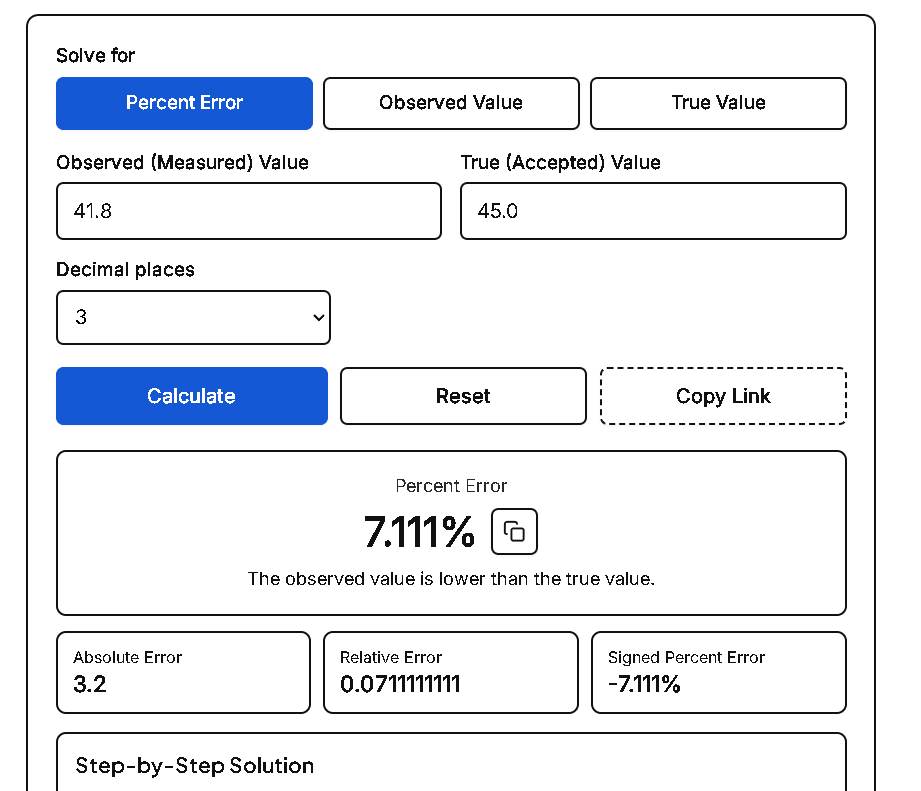
Observed = 41.8, True = 45.0
- Formula: |41.8 − 45| ÷ |45| × 100
- Subtract: 41.8 − 45 = −3.2
- Absolute value: |−3.2| = 3.2 (this is the absolute error)
- Divide: 3.2 ÷ 45 = 0.071111 (this is the relative error)
- Multiply: 0.071111 × 100 = 7.1111%
- Rounded to 3 decimal places: 7.111%
Because the observed value is lower than the true value, the signed percent error is −7.111%.
Absolute Error, Relative Error and Percent Error
Absolute error is the absolute difference between the observed and true values. It is not a percentage. It is shown in the same unit as your measurement.
Absolute error = |Observed − True|
Example: A kitchen scale shows 4.35 lb, but the object actually weighs 5.00 lb. The scale is off by 0.65 lb. This is the absolute error.
Relative error compares the absolute error with the size of the true value.
Relative error = |Observed − True| ÷ |True|
In the above example: 0.65 ÷ 5.00 = 0.13. Multiply by 100 and the percent error is 13%.
Percent error = Relative error × 100
You can also convert a decimal to a percent by multiplying by 100. To turn a ratio such as 3.2 ÷ 45 into a percentage, you can use our fraction to percent calculator.
Observed Value vs True Value: What Do the Terms Mean?
True (theoretical) value:
- In chemistry, physics or any science experiment, this is the ideal, established value that is expected from the experiment.
- It is also called the accepted, actual, expected, or exact value.
- In the formula, this value goes in the denominator.
Observed (experimental) value:
- The result you actually get from your experiment or measurement.
- It is also called the measured, estimated, or approximate value.
What happens in the numerator: it is the absolute difference between the observed and true values, meaning the distance between them on the number line. The order does not matter because we take the absolute value: |a − b| = |b − a|. If you see a slightly different version of the formula elsewhere, these alternate terms will help you match it.
In our calculator the labels are: Observed (Measured) Value and True (Accepted) Value.
Formulas at a Glance
| What you want | Formula |
|---|---|
| Percent error | |Observed − True| ÷ |True| × 100 |
| Absolute error | |Observed − True| |
| Relative error | |Observed − True| ÷ |True| |
| Signed percent error | (Observed − True) ÷ |True| × 100 |
| Observed value (from percent error P) | True ± (P ÷ 100) × |True| |
| True value (from percent error P) | Observed ÷ (1 + P ÷ 100) or Observed ÷ (1 − P ÷ 100) |
Signed (Negative) Percent Error
Because the formula uses an absolute value, percent error is never negative. In most cases only the size of the error matters, not its direction.
A negative value is possible when you do not take the absolute value. With this calculator’s signed formula, (Observed − True) ÷ |True| × 100, the result is negative whenever the observed value is lower than the true value.
Example: Observed = 11, True = 16 (without taking the absolute value)
(11 − 16) ÷ 16 × 100 = −5 ÷ 16 × 100 = −31.25%
If the observed value is bigger, the result is positive. For example, Observed = 20, True = 16: (20 − 16) ÷ 16 × 100 = +25%.
What a negative value means: it only means the observed value is smaller than the true value. It does not mean the value is “better” than expected. The best result is 0%, when the observed and true values are equal.
In our calculator:
- The main result is always zero or positive, because it uses the absolute value.
- The Signed Percent Error box shows the direction. Formula: (Observed − True) ÷ |True| × 100.
- It also shows whether the observed value is higher or lower than the true value.
Example 1 (observed value above the accepted value): Speed of sound. Measured = 351 m/s, Accepted = 343 m/s
- Δ = 351 − 343 = 8
- Percent error = |8| ÷ |343| × 100 = 2.332%
- Signed percent = 8 ÷ 343 × 100 = +2.332% (higher than accepted)
Example 2 (observed value below the accepted value): Density of copper. Measured = 8.72 g/cm³, Accepted = 8.96 g/cm³
- Δ = 8.72 − 8.96 = −0.24
- Percent error (magnitude) = |−0.24| ÷ |8.96| × 100 = 2.679%
- Signed percent = −0.24 ÷ 8.96 × 100 = −2.679% (lower than accepted)
Percent Error With a Negative True Value
The absolute value of the true value (|True|) is also used in the denominator. That is why the formula still works when the true value is negative.
Example: True = −40, Observed = −38
- |−38 − (−40)| = 2
- 2 ÷ |−40| = 0.05
- Percent error = 5%
What If You Don’t Know the True Value?
Percent error needs a known true value. If you don’t have one, repeat the measurement several times and report the average with its standard deviation. This shows how consistent (precise) your results are, but it does not show accuracy against a true value.
How to Find the Observed Value From Percent Error
If you know the percent error and the true value and want to find the observed value, use this formula. Here P is the percent error.
Derivation (all steps):
- P ÷ 100 = |E − T| ÷ |T|
- Removing the absolute value bars gives ±: ±(P ÷ 100) = (E − T) ÷ |T|
- Multiply both sides by |T|: ±(P ÷ 100) × |T| = E − T
- Add T to both sides: E = T ± (P ÷ 100) × |T|
Shortcut: E = T × (1 ± P ÷ 100) gives the same two values.
Because of the ± sign, there are two answers. The observed value can be higher or lower than the true value, and the percent error is the same in both cases. (If the percent error is 0%, there is only one answer.)
Example: True value = 250, percent error = 4%
- Absolute error = 4 ÷ 100 × 250 = 10
- So the observed value is 250 + 10 = 260 or 250 − 10 = 240
- Check: |260 − 250| ÷ 250 × 100 = 4%
How to Find the True Value From Percent Error
T = E ÷ (1 + P ÷ 100) and T = E ÷ (1 − P ÷ 100)
Example: Observed = 84, Percent error = 20%
- T = 84 ÷ (1 + 0.20) = 84 ÷ 1.2 = 70
- T = 84 ÷ (1 − 0.20) = 84 ÷ 0.8 = 105
Check:
- |84 − 70| ÷ 70 × 100 = 14 ÷ 70 × 100 = 20%
- |84 − 105| ÷ 105 × 100 = 21 ÷ 105 × 100 = 20%
Both true values are correct.
Special Cases (0%, 100%, Above 100%, Observed Value = 0)
- Percent error = 0%: both formulas give the same value, so there is only one answer (True = Observed).
- Percent error = 100%: 1 − P/100 becomes zero, and you cannot divide by zero, so only one answer exists. Example: Observed = 84, P = 100% → True = 84 ÷ 2 = 42. Check: |84 − 42| ÷ 42 × 100 = 100%.
- Percent error above 100%: the second answer becomes negative. Example: Observed = 84, P = 250% → True = 24 or True = −56. Check: |84 − (−56)| ÷ 56 = 2.5 = 250%. For real-life quantities such as mass or length, a negative true value is not possible, so only the positive answer applies.
- Observed value = 0: the percent error is always exactly 100% for any non-zero true value. If you enter 100%, the true value cannot be determined. If you enter any other percentage, no true value fits. The calculator shows a message in both cases.
Real-Life Example: Measuring Gravity With a Pendulum
Suppose you measure gravitational acceleration in a pendulum experiment and get 9.62 m/s². The standard value of gravitational acceleration is 9.80665 m/s².
- True (standard) value: 9.80665 m/s²
- Your measurement: 9.62 m/s²
- Subtract: 9.80665 − 9.62 = 0.18665 m/s² (this is the absolute error)
- Divide by the true value: 0.18665 ÷ 9.80665 = 0.019033 (relative error)
- Multiply by 100: 1.903%
The percent error is 1.903%.
(Here we subtracted in the order True − Observed. Because we take the absolute value, the answer is the same as Observed − True.)
Common Accepted Values You Can Use as the True Value
If your instructor does not give you a true value, use an accepted value from a reliable source. Type it into the “True (Accepted) Value” box.
| Quantity | Accepted value | Source |
|---|---|---|
| Standard acceleration of gravity | 9.80665 m/s² | NIST (CODATA) |
| Density of aluminum | 2.70 g/cm³ | Chemistry LibreTexts |
| Density of iron | 7.87 g/cm³ | Chemistry LibreTexts |
| Density of copper | 8.96 g/cm³ | Chemistry LibreTexts |
| Speed of sound in dry air at 20 °C | 343.2 m/s (about 343 m/s) | Georgia Tech Physics Book standard acceleration due to earths gravity +4 |
Reference sources can differ slightly in the last digit. For example, iron is listed as 7.874 g/cm³ in one source and 7.87 g/cm³ in another. If your lab manual gives a value, use that one.
Worked Example: Percent Error From Three Lab Trials
A student measures the density of an aluminum cylinder three times. The accepted density of aluminum is 2.70 g/cm³.
| Trial | Measured density (g/cm³) | Absolute error | Percent error |
|---|---|---|---|
| 1 | 2.60 | 0.10 | 3.704% |
| 2 | 2.62 | 0.08 | 2.963% |
| 3 | 2.64 | 0.06 | 2.222% |
Step 1: Find the average (the observed value).
(2.60 + 2.62 + 2.64) ÷ 3 = 7.86 ÷ 3 = 2.62 g/cm³
Step 2: Use the accepted value as the true value.
True = 2.70 g/cm³
Step 3: Calculate the percent error.
|2.62 − 2.70| ÷ 2.70 × 100 = 0.08 ÷ 2.70 × 100 = 2.963%
Enter Observed = 2.62 and True = 2.70 in the calculator to check. The signed percent error is −2.963%, because the average is below the accepted value.
You can also calculate each trial’s percent error and average them with our average percentage calculator. Here the result is the same, because all three trials are below the accepted value. If your trials fall on both sides of the accepted value, average the measurements first, then calculate the percent error.
How to Write Percent Error in a Lab Report
In a lab report, state your measured (experimental) value, the accepted value with its source, and the percent error. Show the formula and one worked line. Round the answer the way your instructor asks, and say whether your result was higher or lower than the accepted value. Then briefly explain possible reasons for the difference, such as instrument limits, reading errors, or an impure sample. Do not claim a cause that you did not test.
Sample sentence:
“The average measured density of the aluminum sample was 2.62 g/cm³, compared with the accepted value of 2.70 g/cm³. The percent error was 2.96%, and the measured value was lower than the accepted value.”
Fill-in template:
“The experimental value of [quantity] was [value and unit], compared with the accepted value of [value and unit] ([source]). The percent error was [x]%, and the measured value was [higher/lower] than the accepted value.”
Percent Error vs Similar Terms
Percent Error vs Percent Difference
- Percent error: used when one value is “true” or accepted. The true value is the divisor.
- Percent difference: used when you compare two measured values and neither one is the “true” value. The divisor is the average of the two values.
Percent difference = |A − B| ÷ ((|A| + |B|) ÷ 2) × 100
Example: A = 14.2 cm, B = 15.0 cm
- |14.2 − 15.0| = 0.8
- Average = (14.2 + 15.0) ÷ 2 = 14.6
- 0.8 ÷ 14.6 × 100 = 5.479%
To compare two measurements like this, use our percentage difference calculator.
Percent Error vs Percent Change
This formula looks similar to percent change. The difference is that percent change compares an old value with a new value, while percent error treats one value as the true (accepted) value. Percent change keeps its sign. For example, going from 50 to 40 is (40 − 50) ÷ 50 × 100 = −20%.
Percent Error vs Margin of Error and Standard Error
These three terms look similar but mean different things:
- Percent error: the relative difference between the observed and true values, expressed as a percentage.
- Standard error: a statistic that shows how much a sample result (usually the sample mean) is likely to vary from the true population value.
- Margin of error: related to the confidence interval. It is calculated by multiplying the standard error by a z-score that matches the chosen confidence level (for example, about 1.96 for 95% confidence).
Where Is Percent Error Used?
- Chemistry labs: comparing measured boiling points, densities or molar masses with accepted values.
- Physics experiments: checking measurements such as gravitational acceleration or the speed of sound.
- Manufacturing: checking that a part’s size stays within its allowed tolerance.
- Calibration: comparing an instrument’s reading with a reference standard.
- Quality control, including pharmaceuticals: checking that measured amounts stay within allowed limits.
Common Mistakes When Calculating Percent Error
1. Using percent error when there is no accepted value.
If both values are experimental and neither is the true value, use percent difference instead.
2. Wrong denominator (dividing by the measured value).
In percent error, always divide by the accepted (true) value.
Example: Measured = 92, True = 80
- Correct: |92 − 80| ÷ 80 × 100 = 12 ÷ 80 × 100 = 15%
- Wrong (divided by 92): 12 ÷ 92 × 100 = 13.043%
A wrong denominator gives an incorrect result (13.043% instead of 15% here).
3. Forgetting the absolute value.
A raw signed difference can be negative. Percent error is usually reported as a positive number (its magnitude). If you want to know the direction, look at the sign of (Observed − True) separately.
4. Using a true value of zero.
The formula breaks because you cannot divide by zero. In this case, report the absolute error instead.
5. Mixing up percent error and relative error.
Relative error is a decimal (for example, 0.15). Percent error is the same value multiplied by 100 (15%). They are the same quantity in two different formats. Some websites use the two terms interchangeably, but in this calculator relative error is the decimal and percent error is the percentage.
6. Confusing percent error with percent change.
Percent change has a sign and compares any two values. Percent error measures accuracy against a known true value.
Frequently Asked Questions
Q1. Is a 5% percent error acceptable?
A: It depends on the field and the instructions you are given. Many teaching labs treat a percent error under 5% as good, and some accept up to 10%. In manufacturing, calibration and pharmaceutical work, tolerances are often much tighter, such as 1% or less, and are set by the relevant specification or regulation. Always check the guideline for your course or industry.
Q2. Can percent error be more than 100%?
Yes. Suppose the true value is positive. Then the percent error will be more than 100% when:
- the observed value is more than double the true value, or
- the observed value is negative.
Example: True = 30
- Observed = 75 → |75 − 30| ÷ 30 × 100 = 150%
- Observed = −10 → |−10 − 30| ÷ 30 × 100 = 133.333%
- Observed = 0 → exactly 100%
An error this large usually points to a major problem, such as a wrong procedure, a unit mix-up, or a faulty instrument.
Q3. Does percent error have units?
No. The units cancel when you divide, so percent error is a plain percentage. But both values must be in the same unit before you calculate. If one is in kilograms and the other in grams, or one in feet and the other in inches, convert first. You can use our kg to g converter, feet and inches calculator or fraction to inches calculator.
Q4. Can I use percent error for temperatures in °C or °F?
It is better not to. Zero on the Celsius and Fahrenheit scales is an arbitrary point, so the percent error changes with the scale. For example, a reading of 98.85 °C against a true 100 °C gives 1.15%, but the same readings in kelvin (372.00 K and 373.15 K) give 0.308%. Convert to kelvin first.
Q5. What is the difference between percent error and percentage points?
If a solution is expected to be 10% concentration but measures 12%, the difference is 2 percentage points, but the percent error is |12 − 10| ÷ 10 × 100 = 20%. Percent error compares the size of the gap with the true value. Percentage points only subtract.
Q6. Why is my percent error huge when the difference is small?
When the true value is very small, dividing by it inflates the result. For example, observed 0.05 and true 0.02 differ by only 0.03, but the percent error is 0.03 ÷ 0.02 × 100 = 150%. In that case, also report the absolute error.
Q7. What should I do if my percent error is too large?
Check these in order:
- The numbers were typed correctly and the true value is in the right box.
- Both values use the same unit.
- The instrument was zeroed and calibrated.
- Repeat the measurement a few times and average the results.
An error that is always in the same direction usually points to a systematic problem such as calibration. Random scatter usually points to measurement or technique problems.
Q8. Does percent error measure accuracy or precision?
Accuracy. Accuracy shows how close a measurement is to the true value, which is what percent error measures. Precision shows how close repeated measurements are to each other, which you see in the spread (standard deviation) of your trials. A result can be precise but not accurate.
Q9. How many decimal places or significant figures should I report?
Follow your instructor’s or lab manual’s rule. A common approach is to match the number of significant figures of your least precise measurement, often two or three. The calculator’s decimal places setting (0 to 6) lets you match this.
Sources
- Percent Error, Chemistry LibreTexts (CK-12 Introductory Chemistry): defines percent error as the absolute value of the error divided by the accepted value, times 100%.
- Measurement Uncertainty, Accuracy, and Precision, OpenStax Chemistry: Atoms First 2e, Section 1.5: covers accuracy, precision and the uncertainty in every measurement.
- Standard acceleration of gravity, NIST CODATA and The International System of Units (SI), NIST Special Publication 330 (2008): the standard value is 9.80665 m/s², while the actual acceleration varies with latitude and elevation.
- Density of Elements, Chemistry LibreTexts: lists aluminum 2.70, copper 8.96 and iron 7.87 g/cm³.
- Speed of Sound, Georgia Tech Physics Book: gives 343.2 m/s for dry air at 20 °C.
Disclaimer: This calculator and page are for educational and general information only. Results depend on the numbers you enter, so check them before using them in a report. Accepted values are listed for convenience. Use the value given in your lab manual, course or official standard when one is specified. For quality-control, safety or regulatory decisions, follow the applicable specification and professional guidance.
Gouse Shah is the Chief Editor of VersaCalculator.com, a software engineer with over seven years of industry experience, and a dedicated student of mathematics. Based in Bengaluru, India, he leads a team of educators who research, code, test, review, and publish each calculator so users get accurate, easy-to-understand answers. He follows a standard quality-check process on all content before it is published.