
Golden Rectangle
Calculate the exact dimensions, area, and proportions of a perfect golden rectangle.
- millimeters (mm)
- centimeters (cm)
- decimeters (dm)
- meters (m)
- kilometers (km)
- inches (in)
- feet (ft)
- yards (yd)
- miles (mi)
- nautical miles (nmi)
- millimeters (mm)
- centimeters (cm)
- decimeters (dm)
- meters (m)
- kilometers (km)
- inches (in)
- feet (ft)
- yards (yd)
- miles (mi)
- nautical miles (nmi)
- millimeters (mm)
- centimeters (cm)
- decimeters (dm)
- meters (m)
- kilometers (km)
- inches (in)
- feet (ft)
- yards (yd)
- miles (mi)
- nautical miles (nmi)
- square millimeters (mm²)
- square centimeters (cm²)
- square decimeters (dm²)
- square meters (m²)
- square kilometers (km²)
- square inches (in²)
- square feet (ft²)
- square yards (yd²)
- square miles (mi²)
- ares (a)
- decares (da)
- hectares (ha)
- acres (ac)
- soccer fields (sf)
What is a Golden Rectangle?
A Golden Rectangle is a geometric shape governed by the golden ratio, a mathematical constant approximately equal to 1.618. This specific proportion dictates a strict relationship between the long side and the short side. Architects, designers, and mathematicians rely on this shape to achieve optimal structural balance and visual harmony.
The defining property of a Golden Rectangle lies in its infinite scalability. If you cut a perfect square from the rectangle’s interior, the remaining space forms a new, smaller rectangle. This smaller shape shares the exact same proportions as the original parent rectangle. You can repeat this division infinitely to create a perfect mathematical fractal.
This self-replicating nature links directly to the constant Phi (Φ). When the ratio of the long side to the short side equals the ratio of the total length to the long side, you have a perfect Golden Rectangle. It represents the visual translation of a mathematical absolute.
The Core Formulas
Understanding the mechanics of a Golden Rectangle requires knowing the exact value of Phi (Φ). Phi is an irrational number calculated using the square root of five.
Φ = (1 + √5) / 2 ≈ 1.6180339887…
In standard geometric notation, let the long side be represented by a and the short side by b. The defining mathematical rule states that the ratio of the long side to the short side must equal the ratio of the total combined length to the long side.
a / b = (a + b) / a = Φ
You can determine every dimension of the rectangle if you possess just one known value. If you know the short side (b), multiply it by Phi to find the long side. If you know the long side (a), divide it by Phi to calculate the short side.
a = b × Φ
b = a / Φ
Calculating the total area involves standard geometric principles, but the proportional rules allow for formula substitution. You can express the entire area formula using just one known side.
Area = a × b
Area = a × (a / Φ)
Area = a2 / Φ
How to Construct a Golden Rectangle
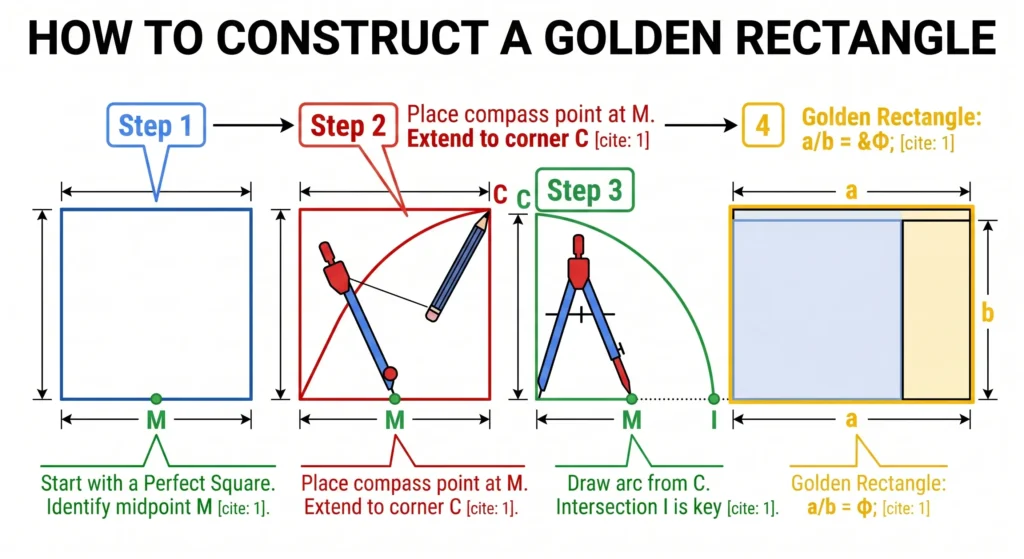
You can build a perfect Golden Rectangle using only a straightedge and a compass. This classical geometric method proves the exact mathematical proportions without requiring complex calculations.
Step one requires drawing a perfect square. Identify the bottom baseline of this square and mark its exact midpoint.
Place your compass point on this newly marked midpoint. Extend the compass pencil to reach either of the opposite top corners of the square.
Draw an arc downward until it intersects with an extension of your original baseline. This intersection point dictates the total length of your new Golden Rectangle.
Draw vertical and horizontal lines from this point to complete the shape. The new small rectangle you added to the original square sits perfectly in the golden proportion to the whole.
The Fibonacci Sequence and the Golden Spiral
The Fibonacci sequence offers a whole-number approximation of the irrational Golden Ratio. This sequence starts with zero and one, and each subsequent number is the sum of the two preceding ones (0, 1, 1, 2, 3, 5, 8, 13, 21…).
As the sequence progresses, dividing any Fibonacci number by its immediate predecessor yields a result increasingly close to Phi. By the time you reach higher numbers, the ratio becomes remarkably precise. For instance, dividing 233 by 144 mirrors Phi to three decimal places.
Fn / Fn-1 ≈ Φ
You can visualize this mathematical relationship by mapping a Golden Spiral. If you take a large Golden Rectangle and continually divide it into smaller squares and proportional rectangles, you create a strict mathematical grid.
Draw a quarter-circle arc through the opposite corners of each nested square. These connecting arcs form a continuous, logarithmic spiral that expands outward at a constant, mathematically defined rate.
Practical Applications
Architects and artists throughout history deliberately employed the golden proportion to achieve visual harmony. While historians debate the exact intentions behind ancient structures like the Parthenon, Renaissance figures explicitly utilized these dimensions. Luca Pacioli and Leonardo da Vinci collaborated on texts mapping these exact mathematical proportions to human anatomy and architectural space.
Photographers use the Phi Grid to frame subjects more naturally than the standard Rule of Thirds. The mathematical intersections of a golden grid draw the viewer’s eye toward the focal point along a logarithmic curve. This positioning creates dynamic tension rather than flat, static framing.
Common Myths Debunked
The internet is full of claims mapping the Golden Ratio to almost everything in nature and classical architecture. Most of these claims rely heavily on confirmation bias rather than exact mathematics. When you draw thick enough lines over a photograph, you can force almost any structure to fit a desired grid.
The Nautilus shell remains the most repeated casualty of this mathematical myth. While the shell does grow in a continuous logarithmic spiral, its actual growth rate almost never aligns with the 1.618 ratio of a true Golden Spiral. Marine biologists have measured thousands of these shells, finding the actual expansion ratio typically hovers closer to 1.33.
The Parthenon in Athens suffers from similar historical revisionism. No surviving Greek texts from that era mention the Golden Ratio in their architectural planning documents. Measurements of the temple’s facade only fit a Golden Rectangle if you arbitrarily include specific structural steps while completely ignoring the roofline.
Mathematical perfection exists as a strict absolute, which is exactly what our digital tool calculates. Human design and organic biological growth tend to approximate structural efficiency rather than rigidly adhering to irrational constants. Rely on the precise numbers for your technical layouts, but allow for necessary flexibility in your final visual execution.