
AP Chemistry Score Calculator
Guesstimate what score you’ll get on each section of the exam and Pep will predict your AP score
Estimate your AP score based on 2025 Exam Scoring Guidelines – these scores may not be 100% accurate
Section I: Multiple Choice
Section II: Free Response
Results
Predicted AP Score
52% of students achieved this score last year
What is the AP Chemistry Score Calculator?
The AP Chemistry Score Calculator is an interactive digital tool designed to help students predict their likely score on the Advanced Placement Chemistry exam. By inputting your estimated performance on both the multiple-choice and free-response sections, this calculator provides an accurate projection of your final AP score on the 1-5 scale. Our calculator uses the most recent scoring guidelines and weightings from the College Board to deliver reliable estimates, helping you identify strengths and target areas needing improvement before exam day.
Unlike static charts or outdated resources, our calculator features real-time updates that immediately show how adjusting your section scores impacts your final result. This dynamic tool is especially valuable for developing effective study strategies and building confidence as you prepare for this challenging exam.
How to Use the AP Chemistry Score Calculator
1. Input Your Scores:
● Multiple-Choice Section: Use the slider to indicate how many of the 60 questions you expect to answer correctly.
● Free-Response Questions: Adjust individual sliders for each of the 7 FRQs (3 long-form worth 10 points each, and 4 short-form worth 4 points each).
2. View Your Results: The calculator instantly displays your:
● Multiple-choice weighted score
● Free-response weighted score
● Total composite score (out of 100)
● Predicted AP score (1-5)
● How your score compares to national distributions
3. Reset and Recalculate: Use the reset button to clear all inputs and perform additional calculations as needed.
Pro Tip: For the most accurate prediction, take a practice exam under timed conditions before using the calculator.
⚙️ How the Calculator Works: Scoring Methodology
Scoring Formula
The calculator uses this precise formula to determine your score:
1. Multiple-Choice Conversion:MCQ Weighted Score = (Number Correct / 60) × 50
2. Free-Response Conversion:FRQ Weighted Score = (Total FRQ Points / 46) × 50
3. Composite Score:Total Score = MCQ Weighted Score + FRQ Weighted Score
4. AP Score Prediction:
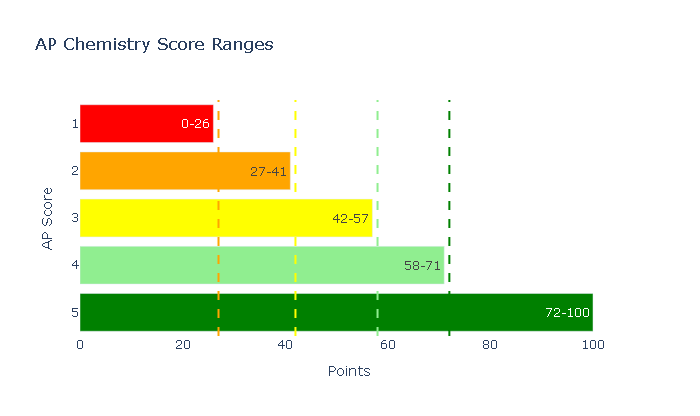
5: 72-100 points
4: 58-71 points
3: 42-57 points
2: 27-41 points
1: 0-26 points
These ranges are may vary slightly from year to year based on exam difficulty and scoring curves.
Calculator Policy Update
Beginning in 2023, the College Board allows calculator use on both sections of the AP Chemistry exam. Our tool reflects this policy change in its design.
Understanding the AP Chemistry Exam Structure
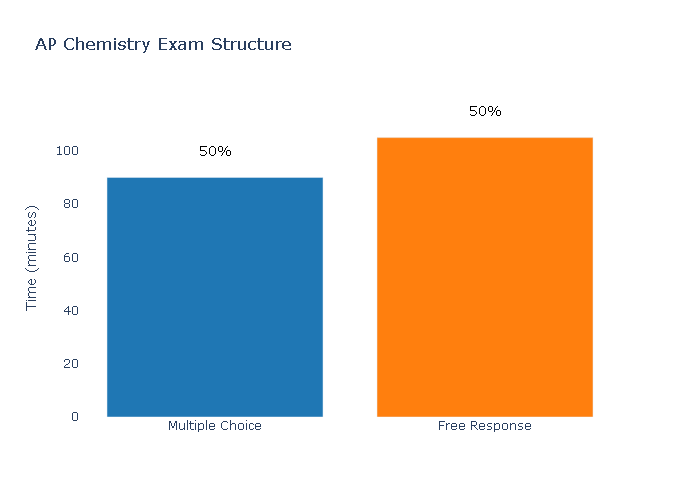
To use the score calculator effectively, it’s important to understand the exam format:
| Section | Question Type | Time | Questions | Weight | Calculator Policy |
|---|---|---|---|---|---|
| I | Multiple Choice | 90 min | 60 questions | 50% | Allowed |
| II | Free Response | 105 min | 7 questions (3 long, 4 short) | 50% | Allowed |
The exam assesses six key science practices through these questions:
1. Models and Representations
2. Question and Method
3. Representing Data and Phenomena
4. Model Analysis
5. Mathematical Routines
6. Argumentation
Historical Score Distributions
| AP Score | 2024 Percentage | Description |
|---|---|---|
| 5 | 17.9% | Extremely well qualified |
| 4 | 27.4% | Well qualified |
| 3 | 30.3% | Qualified |
| 2 | 16.9% | Possibly qualified |
| 1 | 7.5% | No recommendation |
These distributions demonstrate that while AP Chemistry is considered challenging (with approximately 75% of test-takers earning scores of 3 or higher), strategic preparation can lead to success.
How to Improve Your AP Chemistry Score
If Scoring Below 42 (Aim for 3+):
● Focus on Foundation: Master essential concepts in stoichiometry, atomic structure, and states of matter.
● Practice Mathematical Routines: Become proficient in the mathematical aspects of chemistry, including logarithmic calculations for pH and equilibrium constants.
● Learn the Formula Sheet: Familiarize yourself with the AP Chemistry formula sheet provided during the exam to save time.
If Scoring 42-57 (Aim for 4+):
● Target FRQ Strategies: Practice outlining responses before writing to ensure complete answers that address all question parts.
● Master Experimental Analysis: Focus on questions involving data interpretation and experimental design.
● Improve Time Management: Practice completing questions within the recommended time limits (approximately 90 seconds per MCQ)
If Scoring 58+ (Aim for 5):
● Refine Precision: Focus on significant figures, proper units, and clear justification of answers.
● Practice Complex Applications: Work on multi-concept problems that appear in the latter parts of the FRQ section.
● Take Full-Length Practice Exams: Simulate testing conditions to build stamina and identify remaining weak areas.
🧠 The Science Behind Our Calculator
1. Historical Curve Analysis: We’ve analyzed scoring data from multiple years to create accurate predictions.
2. Section Weighting: Properly accounts for the 50/50 balance between MCQ and FRQ sections.
3. Question Difficulty Weighting: Incorporates the understanding that not all questions are weighted equally within sections.
4. Continuous Updates: We regularly adjust our algorithm based on the latest College Board released information.
FAQ
Is there a penalty for guessing on the AP Chemistry exam?
A: No. The multiple-choice section has no guessing penalty, so you should answer every question.
How many significant figures should I use in my calculations?
A: Use the number of significant figures given in the problem, typically 3 for final answers. Maintain at least one extra digit during intermediate calculations to avoid rounding errors.
Can I use the same calculator for the actual exam?
A: Yes, a scientific or graphing calculator is recommended for both sections of the AP Chemistry exam.
How accurate is this score calculator?
A: Our calculator provides estimates within ±1 score point for most students, based on recent curves.
What is a “good” AP Chemistry score?
A: Scores of 3, 4, or 5 are generally considered passing, though many competitive colleges only award credit for scores of 4 or 5.
Our AP Chemistry Score Calculator is designed to be the most accurate and user-friendly prediction tool available. While it provides excellent guidance, remember that actual exam performance depends on many factors including preparation quality, test-day conditions, and specific exam variations. Use this tool as part of a comprehensive study plan for best results.