
LED Series Resistor Calculator
Find the correct current-limiting resistor value to safely power your LEDs using Ohm’s Law.
Calculated Results
Schematic Diagram
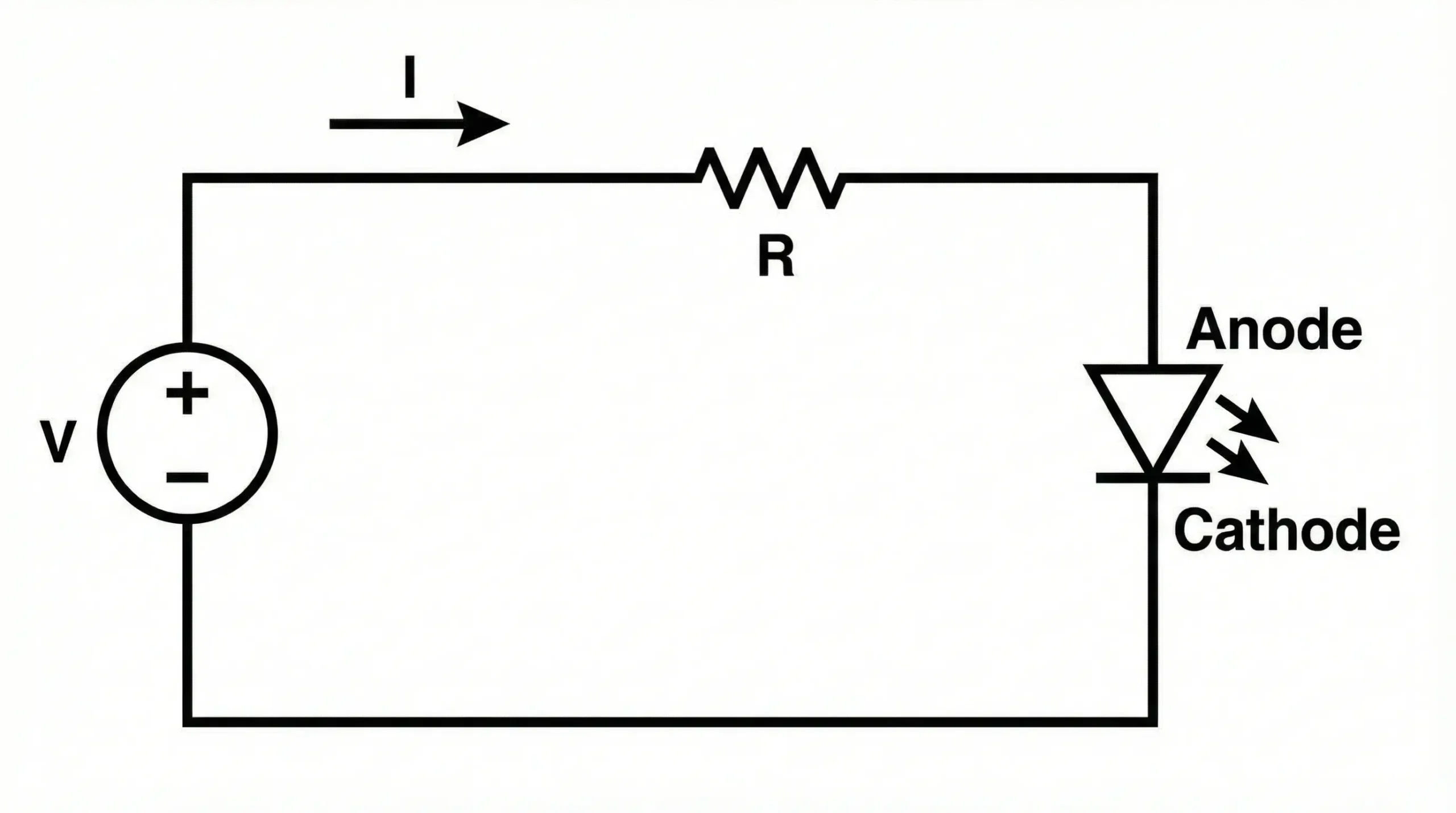
Why You Need a Resistor for Your LED
If you connect an LED directly to a battery or power supply without a resistor, it will likely flash brightly for a split second and then burn out forever. This happens because LEDs (Light Emitting Diodes) are “current-hungry” devices. They try to draw as much power as the source can provide, leading to a phenomenon called thermal runaway.
The series resistor acts as a gatekeeper. It limits the current flowing through the LED to a safe level (usually 20mA for standard LEDs), ensuring your light stays bright without overheating.
How We Calculate the Value
This calculator uses Ohm’s Law, specifically adapted for a series circuit. To find the correct resistance, we need to know how much voltage the resistor needs to “eat up” to protect the LED.
The formula is:
R = (Vs - Vf) / If
Where:
- R is the Resistance (measured in Ohms, Ω).
- Vs is the Supply Voltage (e.g., 9V battery, 12V car battery).
- Vf is the LED Forward Voltage (the voltage the LED “consumes”).
- If is the Forward Current (the current you want to flow, in Amps).
Example Calculation
Imagine you have a 9V battery and a standard Red LED (which typically needs 2V) and you want to run it at 20mA (0.02 Amps).
- First, find the voltage the resistor must drop:
9V - 2V = 7V - Then divide by the current:
7V / 0.02A = 350Ω
You would need a 350Ω resistor.
Common LED Voltages
If you don’t have the datasheet for your specific LED, you can use these standard averages for the “Forward Voltage” (Vf) field in the calculator above:
- Red: 1.8V – 2.2V
- Orange / Yellow: 1.9V – 2.1V
- Green: 2.0V – 3.0V (High-brightness green is often higher)
- Blue / White: 3.0V – 3.4V
- UV (Ultraviolet): 3.1V – 4.0V.
Note: The standard current for 3mm and 5mm LEDs is usually 20mA. High-power LEDs (like those in flashlights) require significantly more.
Nearest Standard Resistor Value
You will notice the calculator often gives you a very specific number, like 137.5Ω. You won’t find a resistor with this exact value at an electronics store.
Resistors are manufactured in standard values (E12 or E24 series). You should always choose the next highest standard value.
- Calculated: 137.5Ω
- Choose: 150Ω
If you choose a lower value (like 120Ω), you allow more current than you planned, risking the life of the LED. If you choose a higher value, the LED will be slightly dimmer, but safe.
Don’t Ignore Power Dissipation (Wattage)
Many beginners calculate the resistance correctly but forget about the heat. Resistors don’t just slow down electricity; they turn that excess energy into heat. If a resistor gets too hot, it can smoke or fail.
Our calculator provides the Power Dissipation in Watts.
- The formula used is:
P = Vdrop * If
Most standard small resistors are rated for 1/4 Watt (0.25W).
- If your calculated power is 0.1W, a standard 1/4 Watt resistor is perfect.
- If your calculated power is 0.4W, a 1/4 Watt resistor will burn up. You need to upgrade to a 1/2 Watt (0.5W) or 1 Watt resistor.
FAQs
Q1. Can I connect multiple LEDs in series?
A: Yes. If you wire LEDs in a chain (positive to negative), you add their voltages together.
- Formula:
R = (Vs - (Vf1 + Vf2 + ...)) / I - Restriction: The total voltage of all LEDs must be less than your supply voltage. You cannot run three 3V LEDs (Total 9V) on a 5V battery.
Q2. Why is my LED dim?
A: You likely used a resistor with too high of a value, or your battery voltage has dropped. Check your calculations and ensure your “Supply Voltage” is accurate.
Q3. Does it matter which side of the LED the resistor goes on?
A: No. In a series circuit, the current is the same everywhere. You can place the resistor on the positive (anode) side or the negative (cathode) side; it will limit the current exactly the same way.