
Free 50-30-20 Budget Calculator
Master your finances with the proven 50-30-20 budgeting rule
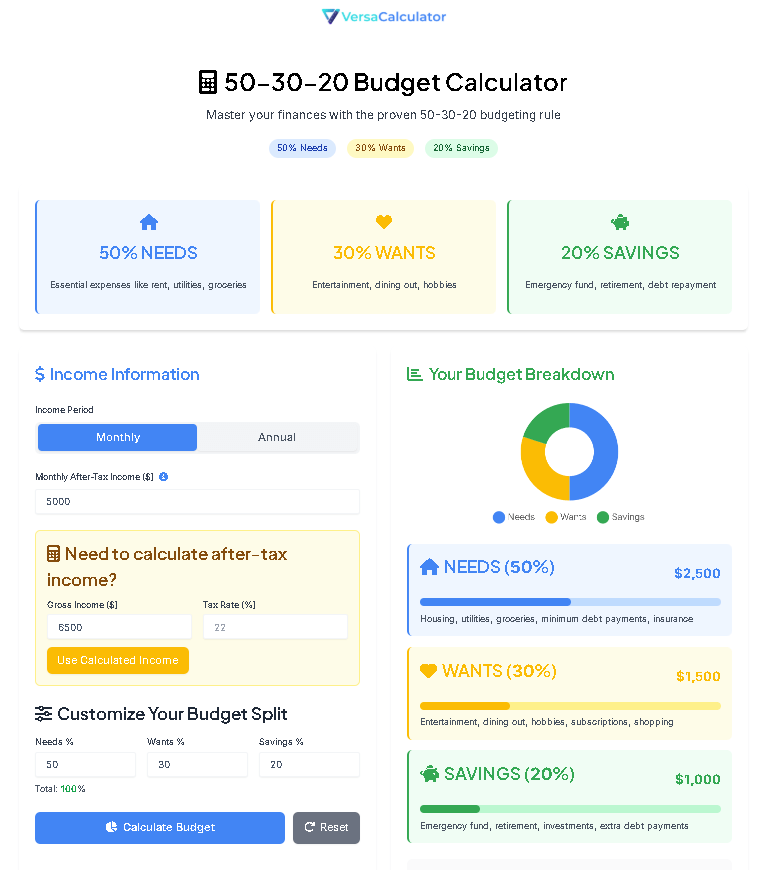
50% NEEDS
Essential expenses like rent, utilities, groceries
30% WANTS
Entertainment, dining out, hobbies
20% SAVINGS
Emergency fund, retirement, debt repayment
Income Information
Need to calculate after-tax income?
Customize Your Budget Split
Your Budget Breakdown
NEEDS (50%)
$2,500WANTS (30%)
$1,500SAVINGS (20%)
$1,000Annual Projections
Enter your income to see your budget breakdown
Personalized Tips & Recommendations
Smart Money Tips
Emergency Fund Goal
How to Use Our 50/30/20 Budget Calculator
1. Enter Your Income: Input your monthly after-tax income (take-home pay). If you know your gross income, use our built-in tax calculator to estimate your net income.
2. Customize Percentages (Optional): While 50/30/20 is the default, adjust the splits to match your goals (e.g., increase savings to 25%).
3. Click Calculate: Instantly see your monthly and annual allocations across all three categories.
4. Review Visual Breakdown: Analyze the color-coded chart and progress bars to understand your money distribution.
5. Set Emergency Fund Goals: Use the integrated emergency fund calculator to determine your target savings based on your needs category.
Formulas Behind the Calculator
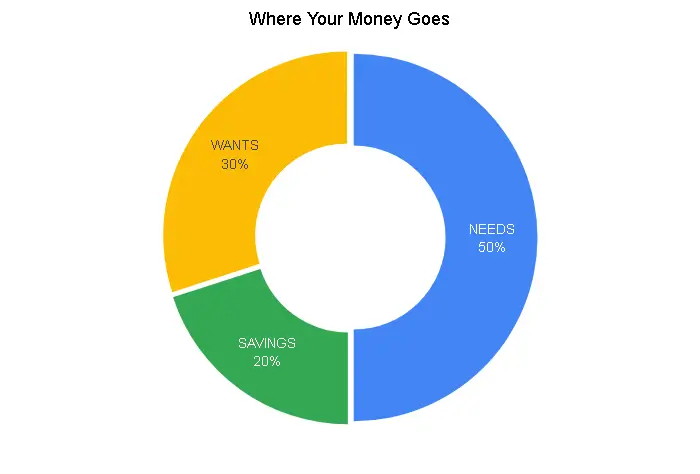
● Monthly Needs Allocation: Monthly Income × 0.5 (or custom percentage)
● Monthly Wants Allocation: Monthly Income × 0.3 (or custom percentage)
● Monthly Savings/Debt Allocation: Monthly Income × 0.2 (or custom percentage)
● Annual Projections: Monthly allocation × 12
● Emergency Fund Target: Monthly Needs × Number of Months (typically 3-6)
Is the 50/30/20 rule realistic for low incomes?
Yes, but may require adjustments. Those with lower incomes often have a higher percentage going to needs. The framework still helps prioritize limited resources.
Advanced Calculation: Incorporating Tax Planning
● Federal and state income taxes
● Social Security and Medicare taxes
● Health insurance premiums
● Retirement plan contributions
● Other payroll deductions
Implementing Your 50/30/20 Budget: Practical Strategies
Automating Your Financial Plan
Set up systematic transfers that align with your pay schedule:
- Direct deposit splitting into multiple accounts
- Automatic transfers to savings and investment accounts
- Bill pay systems for regular expenses
Tracking and Adjustment Techniques
- Weekly check-ins to monitor category spending
- Monthly reviews to assess alignment with targets
- Quarterly adjustments for income changes or goal shifts
Handling Variable Income
For those with irregular income (freelancers, commission-based workers):
● Calculate baseline income using a 6-12 month average
● Prioritize needs during high-income months
● Build buffer savings for lower-income periods
Comparing Budgeting Methods
| Method | Best For | Key Feature |
|---|---|---|
| 50/30/20 Rule | Those seeking balance and simplicity | Percentage-based allocation |
| Zero-Based Budgeting | Detailed financial management | Every dollar assigned a purpose |
| Envelope System | Visual learners and cash users | Physical or digital category limits |
| Pay-Yourself-First | Savings prioritization | Savings allocated before spending |
| 60/30/10 Variation | High-cost areas or lower incomes | Larger needs allocation |
Advanced Financial Planning
Debt Management Strategies
● Debt avalanche method: Prioritizing high-interest debts
● Debt snowball method: Paying off smallest balances first for psychological wins
● Refinancing options: potentially lowering interest rates
Investment Integration
● Emergency fund (3-6 months of needs)
● Retirement accounts (401(k), IRA)
● Taxable investment accounts
● Health savings accounts (HSA)
Life Event Planning
● Job changes: Income fluctuations requiring budget recalibration
● Home ownership: Shifting from rent to mortgage and maintenance costs
● Growing family: Adjusting for childcare, education, and larger housing
Troubleshooting Common Budgeting Challenges
When Percentages Don’t Balance
● Evaluate needs vs. wants: Some expenses may need reclassification
● Consider geographic solutions: Relocation or remote work options
● Income enhancement: Side hustles or skill development
Managing Financial Stress
Start with small adjustments: 5% changes feel more manageable
Celebrate progress: Recognize positive financial behaviors
Seek professional guidance: Financial advisors can provide personalized strategies.
What if my percentages don’t equal 100%?
The Future of Your Finances
● Flexibility is essential: Life changes require budget adjustments
● Consistency matters: Regular small efforts create significant long-term results
● Progress over perfection: Temporary deviations don’t define financial success